
Facts & Resources
We can and must take action to mitigate the ongoing plastic pollution problem in Western North Carolina. Plastics — especially single-use plastics — are clogging up our rivers and streams, posing grave threats to native biodiversity and overall ecosystem health.
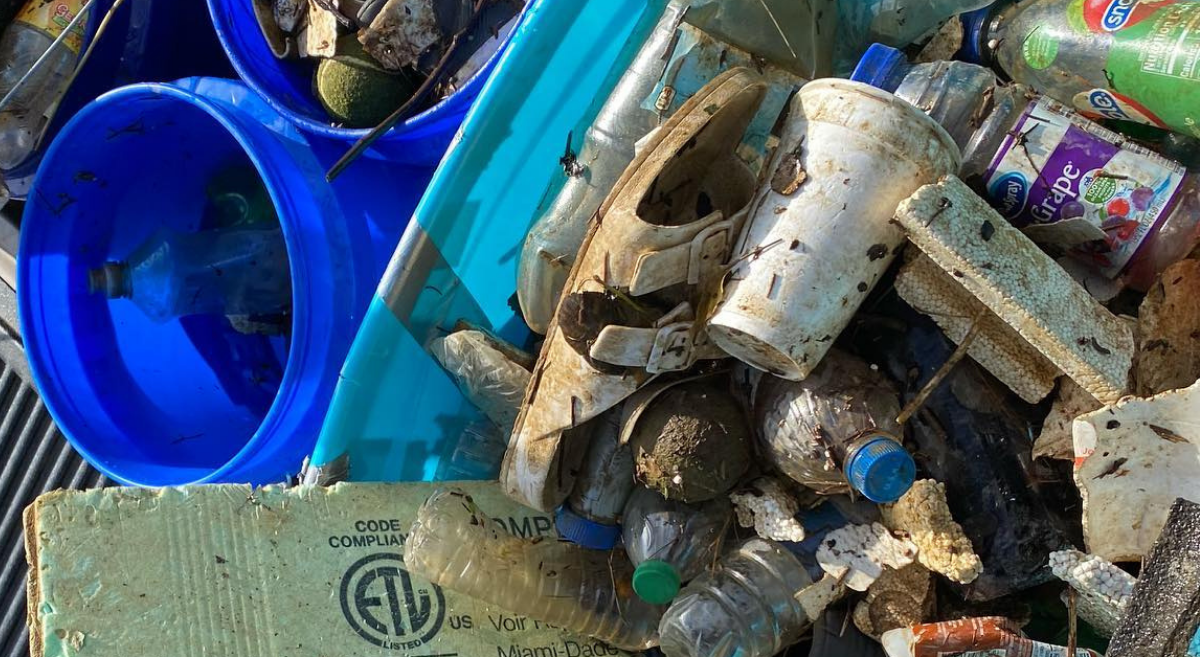
Microplastics in WNC
Plastic Pollution in WNC
microplastics are present in the french broad river…
MountainTrue has conducted widespread microplastic sampling throughout the French Broad Watershed.
The most common type of microplastics in the French Broad River are films (39.5%), the sources of which are plastic bags, food packaging, and candy wrappers.
Other common microplastic sources include fibers (31.5%) — from fishing lines, synthetic clothing, and nylon rope —and fragments (29%) from hard plastics, bottles, toys, and styrofoam.

And in the Watauga and new river watersheds.
MountainTrue has also utilized a Trash Trout to collect single-use plastic waste samples along Winkler Creek — a tributary of the New River that flows through the Town of Boone. Single-use plastics accounted for 86.4% of all items found in the Trash Trout.
The most common single-use plastic items found in the Trash Trout include cigarette butts (4.8%), plastic bags (2.7%), balloons (0.07%), plastic straws (0.52%), plastic bottles (7.6%), and styrofoam (84.2%).

Microplastics and Health: Scientific Research and literature
Proof of microplastics in human blood
Microplastics were found to circulate in the bloodstream across a majority of tested healthy donors.
Significance: Shifted the scientific framework from conceptual environmental exposure to proven internal systemic absorption.
Reference: Leslie, H. A., et al. (2022). Discovery and quantification of plastic particle pollution in human blood. Environment International, 163, 107199. https://doi.org/10.1016/j.envint.2022.107199

microplastics link to cardiovascular events and death
Polyethylene and polyvinyl chloride were detected inside surgically removed carotid artery plaques. The patients with these findings were at a significantly higher risk of heart attack, stroke, or death over a 34-month follow-up.
Significance: Provided the first major clinical data connecting localized micro-and nanoplastic accumulation within human atheromas to adverse cardiovascular outcomes.
Reference: Marfella, R., et al. (2024). Microplastics and nanoplastics in atheromas and cardiovascular events. New England Journal of Medicine, 390(10), 900–910. https://doi.org/10.1056/nejmoa2309822

microplastics found in the intestine
Microplastics were found in human stool samples across a diverse international cohort.
Significance: Confirmed that environmental microplastics successfully enter the human intestine, laying the groundwork for investigating gut microbiome interactions and intestinal barrier penetration.
Reference: Schwabl, P., et al (2019). Detection of various microplastics in human stool: A prospective case series. Annals of Internal Medicine, 171(7), 453–457. https://doi.org/10.7326/M19-0618

Microplastics and Crohn’s disease and ulcerative colitis
Demonstrated that fecal microplastic concentrations are significantly elevated in patients diagnosed with inflammatory bowel disease (IBD) compared to healthy control subjects, with particle burdens showing a positive correlation with clinical disease severity.
Significance: Provided the first direct comparison of gastrointestinal plastic burdens between IBD patients and healthy individuals, raising critical questions about whether high plastic exposure increases the severity of IBD, or if IBD weakens intestinal barriers and increases plastic accumulation.
Reference: Yan, Z., et al (2022). Analysis of microplastics in human feces reveals a correlation between fecal microplastics and inflammatory bowel disease status. Environmental Science & Technology, 56(1), 414–421. https://doi.org/10.1021/acs.est.1c03924

microplastics significantly higher in preTerm birth placentae
Pre-Print: Microplastic concentrations are significantly higher (by 28%) in preterm birth placentae.
Significance: The presence of microplastics may cause inflammation that triggers premature labor.
Reference: Campen, M. J., et al. (2025). Elevated micro- and nanoplastics detected in preterm human placentae. Toxicological Sciences, klaf023. https://doi.org/10.1093/toxsci/klaf023

Microplastics’ association with preterm birth globally
The plastic additive di-2-ethylhexylphthalate (DEHP) may have contributed to roughly 1.97 million preterm births globally in a single baseline year (representing over 8% of the world’s total premature deliveries) and tens of thousands of newborn deaths.
Reference: https://www.thelancet.com/journals/eclinm/article/PIIS2589-5370(26)00089-1/fulltext
Two of the most commonly used chemicals in plastic manufacturing:
styrene

Styrene is used to make styrofoam cups, food containers, and disposable coolers, leaching into the food and drinks they hold and from landfills into drinking water. It’s classified as a likely human carcinogen that causes liver, kidney, and circulatory problems.
phthalates

Used to enhance the durability of plastic products, phthalates can be found in personal care products, food packaging, children's toys, shower curtains, and more. These chemical additives disrupt the endocrine system and harm the reproductive and nervous systems. They have also been linked to higher rates of childhood asthma and other respiratory conditions.
So commonly used, these harmful chemicals leach into the environment with ease.
False solutions:
-

Waste-to-energy (incineration)
Waste incineration is often presented as an alternative to landfills or even as “recycling” because energy can be generated from burning the plastic, though we don’t consider this to be true recycling.
-

Waste-to-fuel (incineration)
Burning plastic undermines source reduction and gives plastic producers a cover to keep making more plastic and generate even more waste. Burning waste is known to produce lead and mercury emissions, which can cause learning and developmental disabilities, as well as respiratory and reproductive issues.
-

Chemical recycling
Chemical recycling includes gasification, pyrolysis, hydropyrolysis, methanolysis, enzymatic breakdown, and waste-to-fuel. The sad, unjust truth is that incinerators and chemical recycling facilities are almost always sited near vulnerable populations.
Treating plastic pollution as a waste management issue is never going to solve the problem. PLASTIC POLLUTION IS AN ENVIRONMENTAL JUSTICE ISSUE REQUIRING systemic change.
We must reduce plastics at the source. Individual and voluntary efforts are great, but game-changing solutions require political intervention.
Plastics are a product of the fossil fuel economy, and while some plastics are beneficial due to their unique properties as a material, the vast majority of plastics are single-use and disposable.
Plastics are flawed by design, in that they are designed to be used briefly and disposed of, then persist for centuries.